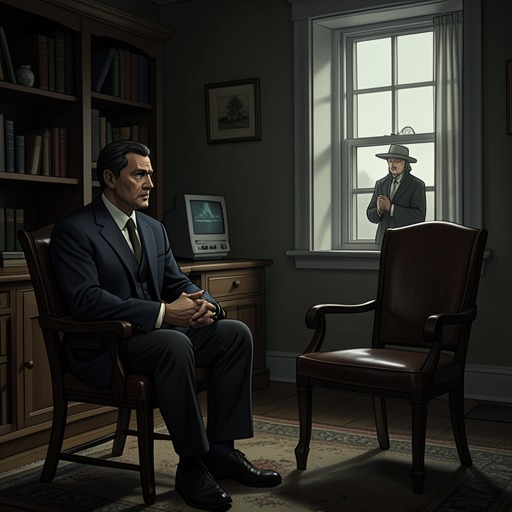
Richard Tolman
American PrometheusRichard Tolman was a distinguished chemist and mathematical physicist whose scientific advice reached Washington during the war, but his place in J. Robert Oppenheimer’s life was equally consequential as friend, host, and confidant. He helped make Pasadena a refuge for Oppenheimer, encouraged his postwar return to teaching in California, and introduced him to astronomers whose work helped set Oppenheimer on a new line of research. Tolman’s death in 1948 later became entangled with contested claims about Oppenheimer’s relationship with Ruth Tolman, turning an intimate friendship into a source of public suspicion.
Identity and Scientific Connections
Tolman was an established scientist with interests broad enough to span chemistry, mathematical physics, and the social implications of science. During the war he worked closely with Oppenheimer and served as General Leslie Groves’s scientific adviser in Washington. His wartime experience placed him among the people who could carry scientific judgments into the machinery of government, although the account of his later appointment as Bernard Baruch’s adviser suggests that this position did not necessarily give him the force or influence to shape policy as he wished.
Tolman also helped direct Oppenheimer toward astrophysics. Their friendship brought Oppenheimer into contact with astronomers at Mt. Wilson Observatory, and the new intellectual terrain fed into work that became some of Oppenheimer’s most original. In 1938, Oppenheimer and Robert Serber published a study of the stability of stellar neutron cores; a few months later, Oppenheimer and George Volkoff developed calculations about massive neutron cores, whose instability beyond a certain limit would become associated with the Oppenheimer-Volkoff limit. Tolman’s contribution in this account is not a coauthorship but an introduction: he opened a path from their friendship into a field where Oppenheimer would make a lasting mark.
A California Home and a Close Friendship
Oppenheimer and Tolman met in Pasadena in 1929, and their connection soon extended beyond professional company. That summer the Tolmans visited the Oppenheimer ranch in New Mexico. The following spring, when Julius and Ella Oppenheimer came to see their son, Robert introduced them to Richard and Ruth Tolman. The families shared dinner and teas, and Ruth took the elder Oppenheimers to a Tchaikovsky concert in Los Angeles. The friendship thus became part of Oppenheimer’s family life, not simply an alliance between colleagues.
The Tolmans’ Pasadena home offered a durable place of welcome. Their whitewashed Spanish-style house stood near the campus, with a lush garden and a one-bedroom guesthouse where Oppenheimer stayed when he came to teach at Caltech. He divided his time between Berkeley and Pasadena, returning each late spring and often joining the Tolmans’ informal dinners. Those evenings brought together a close circle of friends, including Frank Oppenheimer, Linus Pauling, Robert and Charlotte Serber, and Edwin and Ruth Uehling; Frank and Ruth sometimes played the flute. The guesthouse and table made friendship tangible: Oppenheimer had a place to stay, familiar company, and a household that became a recurring counterweight to the demands of his professional life.
Oppenheimer described his friendship with the couple as “very close.” He admired Richard’s “wisdom and broad interests, broad in physics and broad throughout,” as well as his civility, and remembered the Tolmans as a “sweet island in the Southern California horror.” The affectionate description captures both the range of the bond and its setting: a trusted domestic refuge within the busy California world in which Oppenheimer built his scientific career. He later called Richard “a very close and dear friend of mine.” Frank Oppenheimer likewise remembered that “Robert loved the Tolmans—especially Ruth.”
Advice, Return, and the Baruch Appointment
After the war, Tolman helped influence Oppenheimer’s professional choices. He and Charles Lauritsen urged Oppenheimer to come to Caltech full-time, and Tolman had been among those who persuaded him to resume teaching there after the war. Oppenheimer’s return was not automatic. He had offers from several universities and was also invited back to Berkeley, which he regarded as his real home. At Caltech, President Robert Millikan initially objected to an appointment, judging Oppenheimer a poor teacher and questioning the value of his future contributions to theoretical physics; Millikan also raised the question of whether the faculty had enough Jewish members. Tolman and others persuaded him to reconsider, and Caltech made Oppenheimer an offer on August 31. Tolman’s friendship therefore coincided with practical advocacy at a consequential moment, helping keep a California future open while Oppenheimer weighed competing loyalties and ambitions.
Their association also reached into the contentious debate over postwar atomic policy. Oppenheimer was considered for a scientific-adviser position with Baruch, but after an encounter that left him convinced he could not work with Baruch, he declined. Baruch then turned to Tolman. Oppenheimer’s friend Isidor Rabi thought the refusal a serious mistake, observing that Baruch had obtained “poor old Richard Tolman instead.” Rabi believed Tolman lacked the stamina and force of personality to stand up to Baruch. Oppenheimer himself soon reconsidered his decision, phoning James Conant just hours after turning down the job to admit that he thought he had been foolish; Conant told him it was too late. The episode placed Tolman in the position Oppenheimer had rejected, while also exposing the limits of friendship as a source of political power: affection and scientific standing did not guarantee the leverage required in a policy struggle.
Ruth Tolman, Loss, and Contested Allegations
Richard and Ruth Tolman’s marriage had lasted twenty-four years. Ruth was a clinical psychologist, and friends described the couple as exceptionally well suited; she had encouraged Richard’s interest in psychology and in the social implications of science. Oppenheimer had long cherished their friendship, and he and Ruth grew especially close. The account places the beginning of their affair during the war or perhaps shortly after Oppenheimer returned from Los Alamos, while emphasizing that neither intended it to destroy their respective marriages. Ruth remained friendly with Oppenheimer’s family and was both one of its oldest friends and his special confidante.
In mid-August 1948, Richard suffered a heart attack during a party he and Ruth were hosting at their home. A doctor who was at the scene got him to a hospital within thirty minutes. Richard died three weeks later. Ruth was devastated by the death of the husband she had loved for nearly a quarter century. The chronology and the grief are clear in the account; the claims later attached to them are not established causes of his death.
Some of Oppenheimer’s friends used the tragedy to attack him. Ernest Lawrence, by then openly hostile to Oppenheimer, speculated that Richard’s heart attack had followed discovery of the affair and later asserted that Richard had died of a broken heart. These were Lawrence’s allegations, not a demonstrated explanation for the heart attack. Other testimony complicates the accusation: Jean Bacher insisted that the relationship had been supportive and denied that there had been sexual interest, while Molly Lawrence later told a historian that Richard was still alive at the time of the affair. The record therefore preserves incompatible accounts rather than resolving the private history into a single uncontested story.
Oppenheimer and Ruth continued to see each other after Richard’s death. In letters, Ruth recalled meeting him on a dock in chairs beside the water, lights, and passing planes on the anniversary of Richard’s death; she also described wanting more of their time together and suggested a way to meet again. Those letters convey both continuing attachment and the presence of loss, without suggesting that either intended to dismantle the family ties around them. Ruth remained on friendly terms with Kitty and the Oppenheimer children. Tolman’s death did not end the friendship’s influence on Oppenheimer; it changed its emotional circumstances and exposed it to public scrutiny.
Narrative Significance
Tolman’s importance in Oppenheimer’s story lies partly in how many worlds met at his household: scientific work, family hospitality, professional advice, and an intimate friendship with Ruth. He appears not as an isolated figure defined by one dramatic act, but as a steady presence whose influence is visible through introductions, lodging, encouragement, and counsel. The Pasadena home offered continuity as Oppenheimer moved between Berkeley and Caltech; Tolman’s advocacy helped shape his postwar options; and his appointment as Baruch’s adviser showed how a personal decision by Oppenheimer could alter the role available to his friend.
The later allegations also reveal how private relationships could be turned into political weapons. The evidence records a sudden illness, a death mourned by Ruth, an affair whose timing is described with some uncertainty, and accusations that sought to make the death an indictment of Oppenheimer. By retaining the competing accounts, Tolman’s story resists a tidy moral verdict. He remains both a respected scientist and a beloved friend, while the claims made in the aftermath of his death illustrate how the same intimate bonds that sustained Oppenheimer could be recast as grounds for suspicion.